
When the World Got Out of Hand
It all starts with a “what if we played some tabletop?”
Words that summon both a curse and a blessing.
A curse, because the one who says it usually ends up becoming the so-called “forever DM.” Someone doomed never to play another role—unless some brave soul volunteers to take their place.
A blessing, because I truly believe it’s one of the most fulfilling and personally rewarding hobbies you can dive into. (Though, to be fair, it has a slightly ungrateful side—but we’ll get to that later.)
You start by reading the official adventures. The supplements. The expansions. But there comes a point when what you’re reading just… doesn’t quite feel like your world. Or your needs. Or the story you want to tell.
So you start creating your own village. Or maybe a city for your players to explore freely. You create NPCs for them to meet. Quests that might take them to strange corners inside the walls. Items that offer them moments of pure epicness—or ridiculous fun.
But time passes, and game nights become less frequent. The gap between sessions grows so wide that when (by divine grace) you finally meet again, you spend the first precious minutes just trying to remember what the hell happened last time.
Until the day comes when you stop meeting altogether.
But your world’s still there. Growing.
The NPC you created to be the perfect companion for your players now looks at you with sadness.
The creature waiting for them at the end of their first big mission now stares with disappointment and contempt.
So you keep creating.
A Great War whose heroes have been forgotten.
The global event that completely changed the course of history.
The secluded village where a handful of old champions went to live out their days in peace.
All of it keeps growing. Sharpening. Taking shape.
Coming to life.
That’s what happened with my world, Ar’Endria.
It was never supposed to become a saga.
It was just a backdrop for dice rolls, silly accents, bad jokes, and adventures that went off-script and never came back.
But the more I worked on it, the more the world demanded coherence. Then meaning. Then depth.
And that’s when I realized: this world, and these stories, deserved to be told properly.
But there’s a problem when you try to tame something born from chaos into narrative structure—it resists.
Worlds built for play don’t always behave when you try to turn them into chapters.
They’re wild, loose, full of contradictions.
Which is great for a Saturday afternoon session.
Not so great when you’re trying to write a first act.
But I did it anyway. And I’m still doing it.
This post is about that.
And about why it’s one of the hardest, weirdest, and most beautiful things I’ve ever done as a storyteller.
So grab a coffee, settle in, and come with me on this long journey.
Emergent Narrative ≠ Ready-to-Print Plot
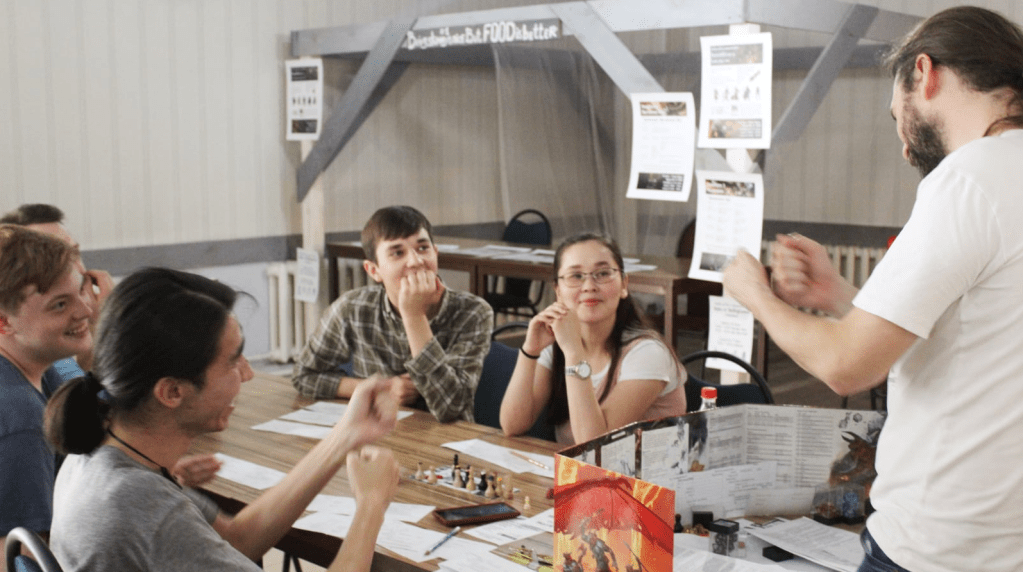
One of the first things you discover when you decide to turn your RPG world into a novel is that what works at the table doesn’t always work on the page.
And I don’t just mean rules or combat. I’m talking about structure. About narrative flow. About those moments that were epic, hilarious, or totally unexpected during the session—and that, when you try to read them cold, inside a novel chapter, just don’t land. Maybe it’s the pacing. Maybe the length. Maybe something else entirely.
They just… don’t work.
Emergent narrative—the one born from improvisation, player interaction, and chaotic dice rolls—is magical in the moment.
It surprises you. Moves you. Blows your mind with the wildest things your players come up with.
But when you try to bring it to the page as-is, you realize it lacks form. It lacks rhythm. It lacks internal logic.
And novels, whether they want to or not, need those three things.
Let’s say you have a shopping episode. Your players spend two-thirds of the session discussing gear, counting coins, negotiating with the shopkeeper, or maybe trying to steal something. They take their time to talk, roll checks, or, let’s be honest, get distracted—because not everyone loves shopping sessions for potion restocking.
Trying to translate that to a novel is always a disaster. No one wants to read a hundred pages of disconnected descriptions and aimless dialogue.
But it’s not just the length.
During the session, those two hours of shopping might fly by—because of what came before, the voices of your players, the body language, the inside jokes, the nervous laughter, the hype of the moment.
In the novel, a marketplace visit should be a bridge—something that moves the story forward. A brief description to set the scene, a quick introduction of the leather worker, and a short exchange of dialogue that reveals something about the characters. That’s all you need to buy a pair of gloves.
That’s also part of the process: understanding that a novel isn’t here to copy the campaign, but to reinterpret it.
To capture its essence, its emotions, its key moments—and shape them into the format the story needs.
It’s hard to let go of moments you remember as legendary.
But if you really want to tell the story well, you have to accept that the literary version won’t be a transcript.
It will be something else.
And hopefully, it’ll still make someone feel something—even if they never rolled a single die.
So, what do you bring over?
Everything. Nothing. And both at once.
Let me explain. Whether you’re a seasoned DM from a decade-long campaign, someone who only plays one-shots, or even someone who’s never played but has a rich world in your head—everything is potential inspiration.
Your players might have created charismatic, unforgettable characters.
Maybe you had an NPC you were dying for the party to meet, but it never happened. Or it did—but the story never went where you hoped.
Everything that happens at the table has the potential to be turned into a story.
But just like I said earlier, you have to take all of it with a grain of salt.
Players aren’t always consistent. They might make decisions in one session that contradict what they did three games ago. Or that NPC you thought would be a fan favorite turns out to be… kind of a boring grump.
The key is to take the best of all those interactions, reactions, and chaos—and shape them.
I see it like sculpting: you start with a lump of clay and chip away chunks until the form hiding inside starts to show.
But in that whole process of shaping and cutting (let’s call it what it is: ruthless trimming), the most important thing to avoid is falling into the campaign diary trap.
That’s the idea that your novel should be written exactly like your sessions went down.
You can’t just write:
“Then they went to the forest. Then they killed an ogre. Then they found a magic key.”
That’s not narrative. That’s a shopping list.
We’ll dig deeper into that idea in another post, but for now, let me share something I’ve learned the hard way:
In writing, “therefore” is way more important than “then.”
Put simply: one drives the story forward with consequence. The other just stacks events on top of each other.
Point of View Changes Everything

At the table, everyone lives the story as it happens.
It’s first-person by nature, and most events occur with the players present. Rarely do you narrate a villain’s secret plan—unless the party uses divination or spying tactics. There’s no additional info for a third party who isn’t there.
But moving from tabletop to novel puts you in a whole new arena: literary perspective.
If you write in first person, you can emulate the table experience—because the reader discovers things as the narrator does.
But if you’re writing in third person, especially with an omniscient narrator, it’s likely that your story will include chapters or sections that focus on characters or events far from the protagonists.
That’s done to give the reader more context, to show them what’s happening backstage, and to make them empathize with what’s coming before the heroes even see it.
So, yeah—you need to be very intentional with your choice of narrator and point of view when translating your world or your campaign to a novel.
And (here I must defend TTRPGs a bit) in many ways, it’s easier to narrate a tabletop session.
Why?
Because everything is a surprise.
Your players don’t know that NPC is a traitor until they discover it—right there, in the moment.
That twist hits hard.
When a reader gets that same reveal in a scene written from the villain’s point of view?
You better hope you’ve nailed the pacing and emotional setup.
Because the impact doesn’t lie in when you reveal something.
It lies in how you tell it.
But there’s more.
Everything we’ve talked about here is just part of what you need to consider when drawing inspiration from your tabletop sessions for your novel. You could write a whole book with the advice and ideas I still have left to share. And you could write an even bigger one with everything I still don’t know.
But that’s why we’re here — to use every tool we have to tell the best stories we’re capable of… and then go further.
So tell me: do you already use some of these tricks?
Got one I should be stealing for myself?
 Dice and Chronicles
Leave a comment