
Remember when we used to play sword fights on the playground? Well, this is the same thing — but with math, dice, character sheets… and no sunlight involved.
Let’s get one thing straight from the start: A TTRPG — Tabletop Roleplaying Game — is a weird, magical, chaotic mix of storytelling, dice, and pure imagination.
If that sentence already made you go, “ehh?”, don’t worry. You’re in the right place.
So, what is it really?
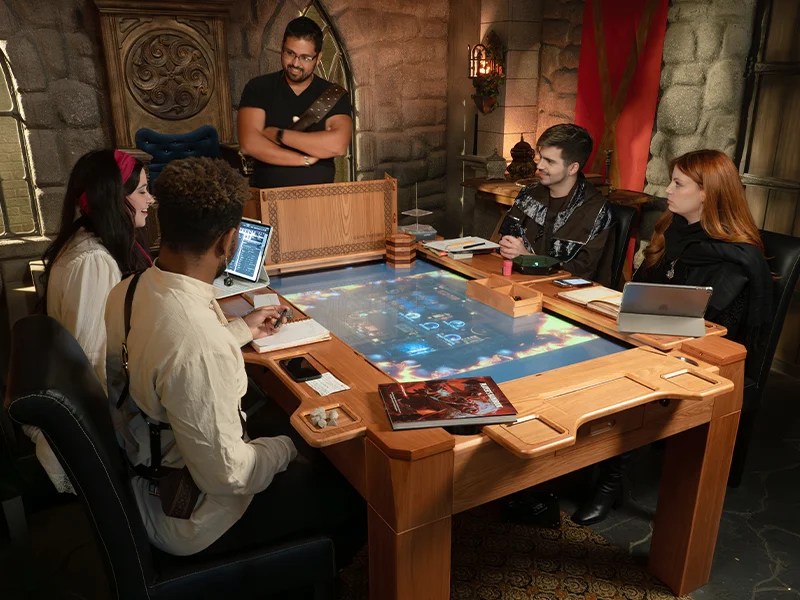
It’s a game where a group of people sit around a table (or, nowadays, a webcam) and play pretend. They take on roles as characters in a fictional world and tell a story together.
No, it’s not like reading a book. And no, it’s not acting either. (Well… sometimes, just a little.)
Think of it as adult make-believe with rules. You describe what your character tries to do, roll the dice to see if it works, and the Game Master tells you what happens next.
It’s chaotic. It’s brilliant. It’s hilarious. And sometimes? It’s surprisingly emotional.
But I’m getting ahead of myself.
In Spain, they call us “frikis de cojones.”
Yep.
Here in Spain, a friki de cojones (roughly translated as massive nerd, but with affection and power) is someone who knows the lore of Forgotten Realms better than actual history.
There are levels of nerdiness, and trust me when I say there’s still a bit of stigma around this hobby. It’s gotten better over the years, especially thanks to Dungeons & Dragons popping up in mainstream media… But we still don’t really have a strong TTRPG culture.
That said, those of us who do get to play — we love it.
All of it.
Because TTRPGs aren’t just for the socially awkward or fantasy-obsessed.
They’re for anyone who’s ever wanted to be part of the story, not just read one.
Okay, but what do you do?
You play a character — like in movies or videogames. Maybe a sneaky rogue. Maybe an alien hunter. Maybe a Vampire Slayer. Maybe a goblin bard with a bone flute. I don’t judge.
You tell the GM (Game Master) what your character tries to do:
“I’d like to break down the door with my axe!”
“I’d like to flirt with the Wookiee using my best charm.”
“I’d like to cast Petrificus Totalus on the Slytherin kid.”
Then you roll a die (usually a 20-sided one), add your character stats, and see if you succeed.
The GM — who’s like the narrator of the story — tells you what happens. Sometimes it goes according to plan. Other times? Not even close.
It’s not about winning. It’s about failing gloriously.
That’s what people don’t get at first.
There’s no “winner” in a TTRPG. You don’t beat the GM, or “win” the session.
It’s not The Players vs. The GM — or the other way around.
The real goal is to live a shared adventure. To build memories, laugh your ass off, panic when someone shouts “Roll for initiative!” and maybe — just maybe — create a story you’ll talk about for years.
You’ll remember:
- The time your party beheaded the zombie grappling another player.
- That one player who kept tripping over because he couldn’t roll over a 1.
- When someone accidentally (they swear) caught the attention of the cultists and started an epic chase through the catacombs.
But isn’t it too complicated?
It can be. There are systems with rulebooks thick enough to stop a bullet. But honestly? You can start with just:
- One person willing to guide a story.
- A few friends ready to have fun.
- A couple of character sheets.
- And a set of dice you can buy for less than a coffee in Madrid.
(Okay, maybe two coffees.)
Some games use just a coin. Others don’t even need a GM. But we’ll get to that glorious mess another time.
What do you play?

That’s the magic. There are games for everyone and everything.
Sure, you can use miniatures, maps, custom tables, sound systems…
But honestly? All you really need is:
- A game system (Dungeons & Dragons, Daggerheart, Call of Cthulhu, or Lasers & Feelings — yes, that’s real).
- A few friends (or strangers from the internet who become friends).
- Dice. Mostly a d20.
- And imagination. That one’s free. Comes pre-installed.
The game system might be the hardest part to choose, simply because there are so many options. Epic fantasy, cosmic horror, cyberpunk, vampires and werewolves, grimdark — and that’s just the popular stuff. If we dive into the indie world or movie adaptations, the list grows almost endlessly.
You can step into the world of movies and books like The Lord of the Rings, or explore the literary universe of Sanderson’s Cosmere. Venture into video game worlds like Dark Souls or Pokémon. Or — one of my personal favorites — create your own seasons in the Buffyverse with Buffy: The Vampire Slayer – The Roleplaying Game.
And what about the Game Master?
The GM is the narrator — I like to call them the referee. They’re the world, the monsters, the bartender, the annoying goose, the whispers in the shadows, and the rules (sort of).
But they’re not the final boss to beat. In fact — and this doesn’t get said enough — your GM should be on your side. That is, they should want you to succeed in the challenges you face, while still playing the role of the puppet master who could rip your character’s head off.
Believe me when I say: deep down, the GM is a cheerleader with pom-poms, jumping with joy every time you do, literally, anything.
They’re a guide — like a film director, but the actors are constantly improvising and no one has a script.
Being a GM is amazing. And chaotic. And probably deserves a whole post of its own.
Why should I care about all this?
Because you might just love it.
You might discover that rolling dice with friends becomes the highlight of your month — or your semester when life gets busier. You might find out you’re better at improvising than you thought. That your brain needed a playground.
TTRPGs help you:
- Be creative.
- Enjoy your friends.
- Process emotions.
- Tell stories you didn’t know were inside you.
It’s therapy. With fantasy animals.
And snacks.
Where do I start?
Right here, frikazo.
This blog is for you — whether you’re curious, confused, or already knee-deep in character voices and lore debates.
We’ll talk about systems, stories, monsters, worldbuilding, writing… and all the weird little joys of the tabletop life.
Welcome to Dice & Chronicles.
Grab some dice.
And let’s roll
 Dice and Chronicles
Leave a comment